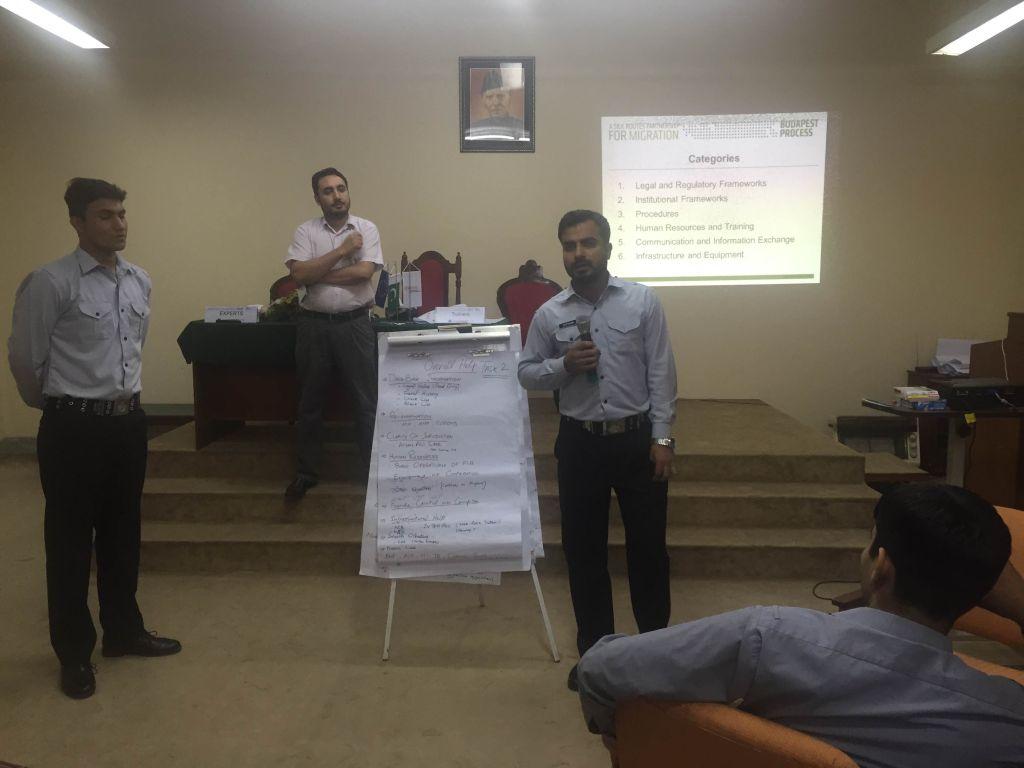
Islamabad, 14-18 September 2015: Islamabad, 14-18 September 2015: The capacity of Pakistan’s Federal Investigation Agency (FIA) to train new investigators and operational staff in anti-trafficking in human beings and border management processes was enhanced during a five day workshop held from 14 – 18 September in Islamabad.
The FIA is the law enforcement authority in Pakistan responsible for investigating and preventing human trafficking and migrant smuggling, as well as other immigration and organised crime issues.
37 new FIA recruits received training over four days from six FIA trainers with the support of international law enforcement experts. The FIA trainers previously participated in a Training of Trainers (ToT) initiative organised under the Silk Routes Partnership Project in April 2015. The training workshop allowed the trainers to put the skills and knowledge gained during the ToT training into practice, as well as supporting the development of the next generation of FIA operational staff and investigators.
The training workshop began with a preparation day just for the FIA trainers to finalise training presentations and materials. The FIA trainers then delivered two days training to new recruits on combating trafficking in human beings, and two days training on integrated border management, with the support of the international training experts. The four days training for the FIA recruits was integrated as a pilot initiative within a 16 week training course that new recruits complete before taking up operational and investigatory roles in the field.
The training applied a highly interactive and participatory approach through the use of case studies and role-playing exercises that sought to simulate the operational reality that new recruits may face with when working in the field. During the first two days, the new recruits learnt about the difference between trafficking in human beings and smuggling of migrants, how to identify a victim of trafficking and conduct screening interviews with suspected trafficked persons. The role of state actors in victim assistance processes was also explained. The latter two days training on Integrated Border Management included the concepts, models and principles of border management, integration of anti-corruption measures and professional standards in border management processes, risk profiling/passenger analysis at borders, and the use of detection methods.
The training was organised in the framework of two complementary ICMPD initiatives: the Support to the Silk Routes Partnership for Migration under the Budapest Process Project and the Fight against Trafficking in Human Beings and Organized Crime – Phase 2 (THB/IFS/2) project, both of which include Pakistan as a key partner country as part of multi-country capacity building projects. Both the Silk Routes Partnership project and THB/IFS/2 project are supported by the European Union.